
What Size Canvas Do I Need? A Room-by-Room Guide
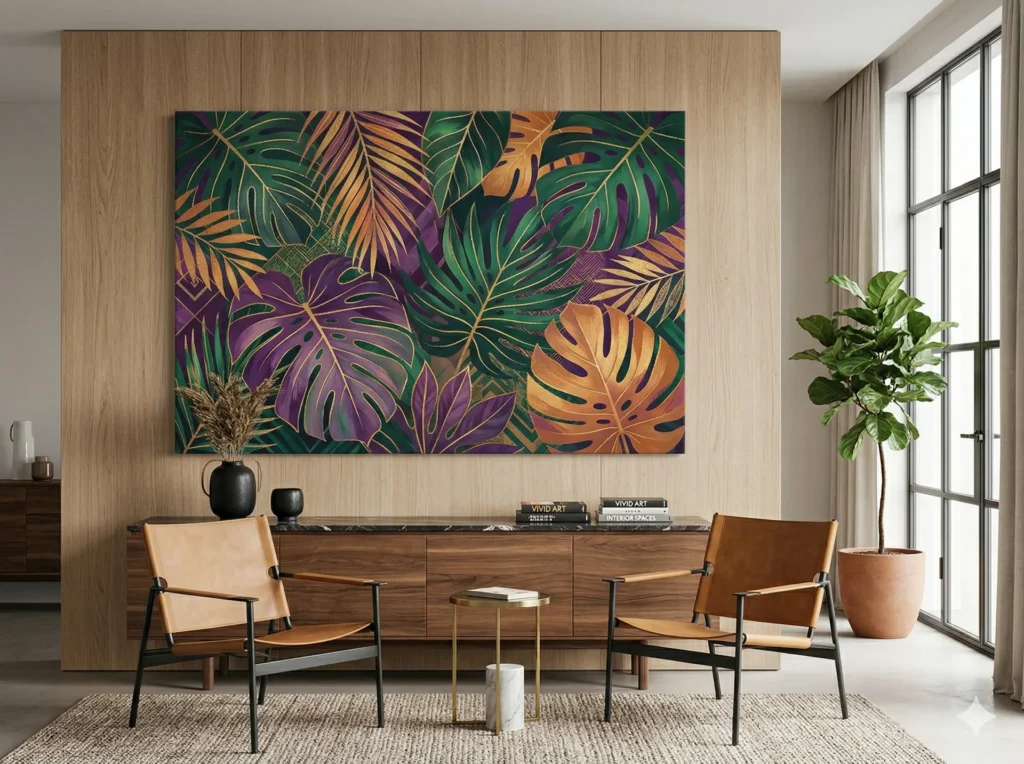
A canvas that’s the right size for the wall changes a room; one that’s too small looks lost, and one that’s too big overwhelms. The good news is you don’t need an eye for interiors to get it right - a couple of simple ratios do most of the work. Here’s how to size a canvas room by room, whatever you’re hanging it above.
The short answer
- Above a sofa or bed → the art should span two-thirds to three-quarters of the furniture’s width.
- On an empty feature wall → fill roughly 60% of the free wall space, leaving a clear margin around the piece.
- Eye level → hang so the centre sits around 145-150 cm from the floor, wherever the room.
Everything below is just those three rules applied to real rooms. Our sizes run in 5 cm steps from 20 up to 100 cm as standard, with custom dimensions to the millimetre if a wall needs something in between.
Above the sofa (living room)
The sofa sets the scale. Measure its width and aim for a piece - or an arrangement - that covers two-thirds to three-quarters of it. A 200 cm sofa wants art around 140-150 cm wide; a compact 160 cm sofa wants roughly 110-120 cm. Leave 15-25 cm of breathing space between the top of the sofa and the bottom of the frame so the two don’t crowd each other.
If a single canvas that wide feels like a lot, this is the classic moment for a multi-panel set - five panels read as one wide statement while staying easy to handle and hang.
Rule of thumb: art width ≈ 0.66-0.75 × sofa width, hung 15-25 cm above the back.
Above the bed (bedroom)
Treat the headboard like the sofa: the piece should sit comfortably within the width of the bed, ideally matching the headboard or a touch narrower. Above a double or king, that usually means one large landscape canvas around 90-120 cm wide, or a balanced pair. Keep the arrangement centred on the bed, not the wall, so it reads as part of the setting.
Rule of thumb: centre on the bed, width ≈ headboard width, calm subjects suit sleep.
Feature walls & empty walls
On a bare wall with no furniture beneath it, let the piece breathe: aim to fill about 60% of the available wall, keeping a consistent margin on all sides. Tall, narrow walls (between two windows, or a stairwell) suit a portrait orientation; wide walls suit a landscape or a horizontal panel set. When in doubt on a big empty wall, go one size larger than feels safe - under-sizing is the more common mistake.
Hallways, kitchens & small walls
Narrow spaces reward restraint. In a hallway, a run of smaller canvases (30-50 cm) at a steady eye level guides you down the space without cramping it. In a kitchen or nook, one well-placed 40-60 cm piece is usually plenty. Small rooms don’t need small art everywhere - but tight walls do.
Portrait, landscape or square?
Match the canvas shape to the wall and the image. Landscape suits wide walls and scenery; portrait suits tall gaps and single subjects; square is the flexible all-rounder that anchors a gallery wall. We support 13 aspect ratios, so most photos crop cleanly to a shape that fits the space you have in mind.
Sizing at a glance
| Spot | Guideline | Typical size |
|---|---|---|
| Above a sofa | ⅔-¾ of sofa width | 110-150 cm wide |
| Above a bed | ≈ headboard width, centred | 90-120 cm wide |
| Feature wall | ≈ 60% of free wall | One large or a panel set |
| Hallway | Series at eye level | 30-50 cm each |
| Kitchen / nook | Single accent piece | 40-60 cm |
A quick way to test it before you buy
Cut a sheet of newspaper or masking-tape a rectangle to the size you’re considering and stick it on the wall for a day. It’s the simplest way to feel whether a size sits right in the actual light of the room - far more reliable than guessing from a screen.
Still not sure?
Our size guide lists every standard dimension, and each product page lets you preview sizes before you decide. Browse the full range of canvas prints - single pieces for a clean statement or five-panel sets for wide walls. Need something bigger than standard? We print custom sizes up to 170 × 500 cm - just get in touch for a quote.
Frequently asked questions
How high should a canvas be hung?
Centre the piece at eye level, roughly 145-150 cm from the floor to the middle of the canvas. Above furniture, measure from the furniture rather than the floor: 15-25 cm above a sofa back keeps the two reading as one group.
What size canvas works above a three-seat sofa?
Aim for two-thirds to three-quarters of the sofa’s width. On a 220 cm sofa that is roughly 150-165 cm of art, either as one large canvas or as a multi-panel set spanning the same span.
What if my wall needs a size you do not stock?
Standard sizes run in 5 cm steps from 20 to 100 cm and are held in stock. Anything outside that is made to your measurements down to the millimetre, up to 170 × 500 cm.
Is one large canvas better than several small ones?
For a single focal wall, usually yes - one confident piece beats three hesitant ones. Several pieces earn their place when the wall is long, when you want movement across it, or when the room already has a lot going on.
What is the most common sizing mistake?
Going too small. A canvas that looks generous on a screen often looks lost on a wall. When you are between two sizes, take the larger one.
Shop this guide
Shop canvas prints by size

Songbird & Rose Sonata


The Long Shadow


Radiant Burst


Red Node Convergence
Read next

Stretcher Bar Profiles & Why Canvas Depth Matters
What canvas depth means and how stretcher bar profiles change the look - from slim standard bars to deep 3D gallery-wrap edges. Made in the EU.

How to Care for a Canvas Print (and Keep Colours Vibrant)
How to clean and care for a canvas print: dry dusting, what to avoid, sunlight and damp, and keeping colours vibrant for years. Made in the…

Turn Your Own Photo Into Canvas: Resolution, Files & Tips
Printing your own photo on canvas? The resolution you need, best file types, cropping tips and how large you can go. Custom sizes to 170x500 cm,…